Voice AI is rapidly changing how businesses interact with customers. From automated support calls to AI-driven sales assistants, voicebots are becoming a core part of modern communication strategies.
However, while many companies focus on building powerful AI models, one critical challenge often slows down deployments—telephony infrastructure.
Voicebots need a reliable way to connect with real phone numbers so they can interact with customers over live calls. For companies operating in India, this requires telecom compliance, low latency, and scalable call infrastructure.
This is where Voicelink Indian Telephony Integration becomes essential.
Voicelink enables voicebot providers to seamlessly connect their AI systems to Indian telecom networks, allowing them to launch real voice interactions quickly and reliably.
The Growing Demand for Voicebot Telephony
Businesses across industries are adopting voicebots to automate customer interactions. Common use cases include:
- Customer support automation
- Lead qualification calls
- Appointment scheduling
- Payment reminders
- Customer feedback surveys
These systems rely on multiple AI technologies such as:
- Speech-to-Text (STT)
- Natural Language Processing (NLP)
- Large Language Models (LLMs)
- Text-to-Speech (TTS)
But to make these technologies work in real-world environments, voicebots must connect to telecom networks that allow inbound and outbound calling.
Without telephony integration, voicebots remain limited to demos or web-based interactions.
Why “international telephony” often fails in Indian voicebot deployments
1) Compliance risk
India’s telecom sector is regulated by the Telecom Regulatory Authority of India (TRAI). Companies must follow specific compliance rules to provision phone numbers and manage call routing.
For many global voice AI platforms, navigating these regulations can be complex.
2) Trust and credibility
3) Call quality and reach
4) Scaling breakdown
Managing these systems requires telecom expertise that many AI startups do not have.
Voicelink supports voice AI and voicebot deployments in India. It acts as the bridge between AI voice platforms and telecom networks, enabling real-time phone conversations powered by AI.
Instead of building telecom infrastructure internally, voicebot providers can connect their systems directly to Voicelink.
This allows voicebot providers to focus on improving conversational intelligence rather than managing telecom systems.
How Voicelink Telephony Integration Works
Voicelink functions as the telephony layer between telecom networks and AI voice systems.
The process typically works as follows:
- A customer calls an Indian phone number powered by Voicelink.
- The call is routed through the Voicelink telephony infrastructure.
- Audio is streamed to the voicebot platform through SIP or WebSocket.
- The AI processes the conversation using STT, language models, and TTS.
- The response is delivered back to the caller in real time.
This architecture enables natural, real-time conversations between customers and AI voice agents.
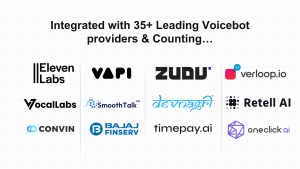
Voicelink’s 35+ Integrations Across the Voice AI Ecosystem
One of Voicelink’s key strengths is its growing integration ecosystem. The platform connects with 30+ tools across the voice AI technology stack, making it flexible for different voicebot architectures.
What “integration-ready telephony” actually unlocks
Use Cases of Voicelink in Voice AI
- Voicebot providers use Voicelink across multiple industries.
- Customer support teams automate repetitive queries and reduce call center workload.
- Sales teams deploy voicebots to qualify leads and schedule appointments.
- Healthcare providers automates appointment reminders and follow-ups.
- Financial institutions use voicebots for payment reminders and identity verification.
- These applications demonstrate how telephony integration enables real-world deployment of conversational AI systems.
Final Takeaway
If you’re building voicebots for real conversations in India, the biggest risk is not your AI model—it’s production telephony.