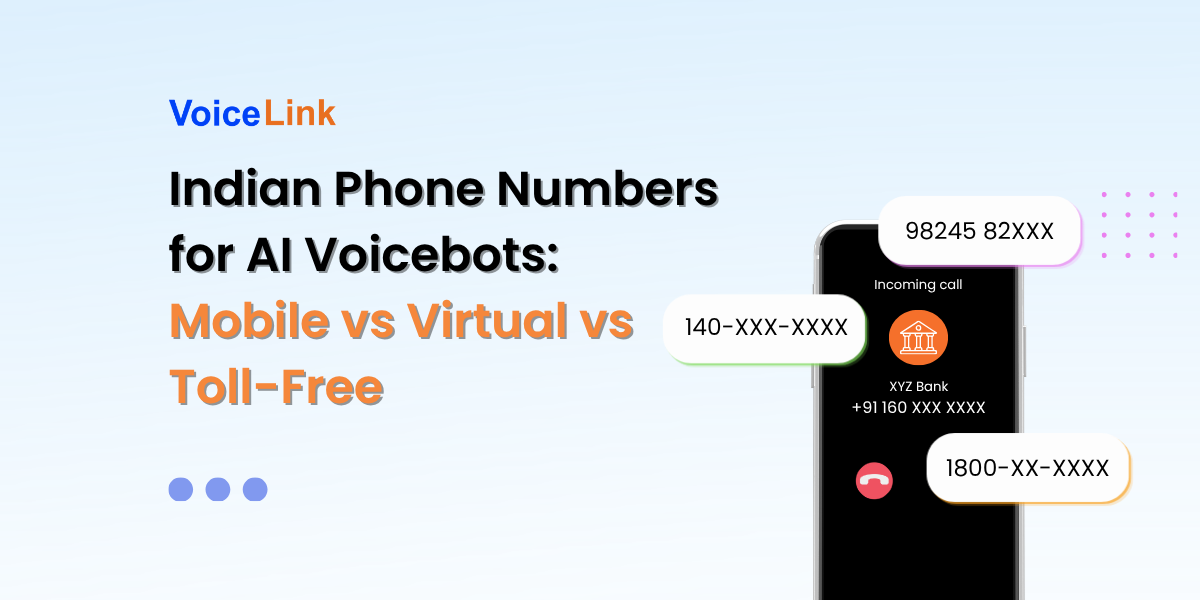
For AI voicebots in India, 10-digit Indian virtual numbers deliver the best call connectivity and pickup rates — customers recognise and answer local +91 numbers. For outbound campaigns, all businesses use the 140-series. The 1600-series is exclusively for BFSI and Government entities regulated by RBI, IRDAI, SEBI, and PFRDA. AI voicebots must disclose their automated nature within 15 seconds and call only between 10 AM and 7 PM. VoiceLink provides all number types with DLT compliance built in.
Which phone number your AI voicebot calls from is not a trivial configuration choice. It is one of the first things your customer sees — before they hear a single word from your AI.
In India, where mobile spam complaints have jumped 128% in three years and customers receive an average of 3 spam calls per day, the number on the screen determines whether a call gets answered or rejected instantly. The right Indian number does not just improve pickup rates — it determines whether your entire campaign runs compliantly or gets blocked by TRAI.
This guide covers every number type available for AI voicebots in India — including the critical compliance rules most businesses get wrong — with clear guidance on when to use each type and what VoiceLink provides.
Why the Phone Number Determines Campaign Success Before the First Word
The decision to answer or ignore happens in under two seconds. In India’s trust-depleted calling environment, that decision is made almost entirely based on the number displayed.
Indians prefer calls from recognised local numbers
Rise in spam call complaints in India over 3 years
Average spam calls received by Indian mobile users
Enterprises already on TRAI 1600-series
When your AI voicebot calls from a +91 Indian number, customers recognise the format. When it calls from an international route or an unrecognised number series, the call gets declined — or worse, flagged as spam by Truecaller before it even rings.
The number type also determines your entire compliance posture: which TRAI series applies, what DLT registration you need, and what penalties apply if you get it wrong.
Why 10-Digit Indian Numbers Deliver the Best Call Connectivity
This is the most important practical insight for any business deploying AI voicebots in India: 10-digit Indian mobile and virtual numbers deliver significantly better call connectivity than any alternative.
Why 10-Digit Numbers Win on ConnectivityIndia’s mobile network is optimised for 10-digit +91 numbers. Calls from Indian 10-digit numbers — whether mobile or virtual — route directly through domestic telecom infrastructure with minimal hops, lower latency, and higher connection rates. International SIP routes, by contrast, traverse multiple network interconnection points before reaching Indian carriers, adding latency, increasing drop rates, and triggering operator-level spam filters that never flag domestic numbers.
The Connectivity Advantages of 10-Digit Indian Numbers
- Direct domestic routing: Calls stay on Indian telecom infrastructure end-to-end — no international handoffs that add 100ms+ latency and drop risk
- Operator trust signals: Indian carriers do not flag domestic +91 numbers the way they flag international routes — lower spam marking, higher delivery rates
- Truecaller recognition: Indian business numbers registered on DLT appear as verified on Truecaller — one of the most-used call screening apps in India with 300 million+ Indian users
- Network compatibility: 10-digit format is natively compatible with every Indian operator — Jio, Airtel, Vi, BSNL — with no format mismatch issues
- Customer familiarity: Indian customers recognise the 10-digit format instantly and are significantly more likely to answer than an unrecognised international number
- Lower call drop rates: Domestic routing reduces call drops caused by international gateway failures or cross-border SIP quality degradation
VoiceLink provides 10-digit Indian virtual numbers and mobile numbers connected directly to Indian telecom infrastructure — ensuring your AI voicebot calls connect reliably, route with minimal latency, and reach customers from a number they recognise and trust.
The Four Number Types for AI Voicebots in India
India’s telecom framework gives voicebot deployments four distinct number options. Each serves a different use case, carries different compliance obligations, and delivers different customer experiences.
Option 1
10-Digit Indian Numbers
Mobile and virtual numbers in the standard Indian 10-digit format. Direct domestic routing, highest connectivity, recognised by every Indian customer. The foundation of all TRAI-compliant outbound AI calling.
Best for: All outbound AI voicebot campaigns requiring maximum connectivity
Option 2
Virtual Landline Numbers
Cloud-based 10-digit numbers with landline format. Professional identity, high scalability, seamless SIP integration. Most popular for enterprise voicebot deployments at scale.
Best for: Enterprise AI receptionists, outbound campaigns, large contact centres
Option 3
Toll-Free Numbers (1800-series)
Free for callers to dial. Strong brand credibility for inbound. Not for outbound AI calling — customers do not recognise 1800 numbers calling them.
Best for: Inbound AI receptionists, customer support helplines
Option 4
140 / 1600-Series Numbers
TRAI-mandated series for outbound AI calling. 140-series for all businesses making promotional calls. 1600-series exclusively for BFSI and Government regulated entities.
Best for: All regulated outbound AI campaigns
The 140 and 1600-Series: What TRAI Actually Requires in 2026
This is where most Indian businesses running AI voicebots get it wrong — often until a campaign gets blocked. The 140 and 1600-series are not interchangeable, and eligibility for 1600-series is strictly limited.
The 140-Series: For ALL Businesses Making Promotional Calls
The 140-series is mandated by TRAI for all promotional and marketing outbound voice calls. Every business — regardless of industry — must use 140-series numbers for promotional AI voicebot campaigns. This includes e-commerce, healthcare, EdTech, real estate, logistics, hospitality, and any other non-regulated sector.
- DLT registration as a Principal Entity is mandatory before first call
- Voice templates must be registered and approved on the DLT platform
- DND scrubbing must occur immediately before each individual call — not at campaign setup
- Calling hours: 10 AM to 7 PM only — calls outside these hours are a TCCCPR violation
- AI disclosure: the voicebot must identify itself as automated within the first 15 seconds
- Explicit consent for transactional variations valid for only 7 days from acquisition
The 1600-Series: Exclusively for BFSI and Government Entities
Critical — Read This Before Assuming 1600-Series AppliesThe 1600-series is not available to all businesses. Eligibility is determined by who you are — a regulated entity — not by what type of call you are making. E-commerce companies, healthcare providers, EdTech platforms, and real estate businesses cannot use 1600-series numbers regardless of whether their calls are transactional or promotional. They must use 140-series for all outbound calls.
The 1600-series is assigned exclusively to entities in the Banking, Financial Services and Insurance sector and Government organisations. TRAI has issued staggered mandatory deadlines:
TRAI 1600-series — eligible entities and mandatory adoption deadlines
| Regulator | Entity Type | Mandatory Deadline |
|---|---|---|
| RBI | Scheduled commercial banks (public, private, foreign) | January 1, 2026 |
| RBI | Large NBFCs, payments banks, small finance banks | February 1, 2026 |
| RBI | Remaining NBFCs, co-operative banks, regional rural banks | March 1, 2026 |
| SEBI | Mutual funds, AMCs, qualified stockbrokers | February 15 – March 15, 2026 |
| PFRDA | Central record keeping agencies, pension fund managers | February 15, 2026 |
| IRDAI | All insurance entities | February 15, 2026 |
| DoT | Government organisations | Mandatory — ongoing |
| All others | E-commerce, healthcare, EdTech, real estate, etc. | Not eligible — use 140-series |
About 570 entities from BFSI have already adopted 1600-series numbers, subscribing to more than 3,000 numbers across all telecom service providers. If your organisation is BFSI-regulated and still using standard 10-digit numbers for service calls, you are already non-compliant.
The Three TRAI Rules Specific to AI Voicebots in 2026
Beyond number series compliance, AI voicebots carry three additional TRAI obligations that standard outbound calling does not. These apply to every AI voicebot campaign regardless of industry or number series.
AI Disclosure Within 15 SecondsUnder TRAI’s current guidelines, your AI voicebot must clearly identify itself as automated within the first 15 seconds of the call. Passing off an AI voice agent as a live human is not just non-compliant — it constitutes deceptive trade practice. Build the disclosure into your opening script before any other content.
Permitted Calling Hours: 10 AM to 7 PM OnlyAI-driven outbound calls must operate only within permitted calling hours of 10 AM to 7 PM IST. Calls outside these hours are a TCCCPR violation subject to immediate penalties. Note: RBI FPC for collections calls has an 8 AM to 7 PM window — the stricter TRAI rule of 10 AM to 7 PM applies for general AI calling.
Pre-Call DND Scrubbing — Every Single CallDND registry data refreshes daily. A number that was clean at campaign setup may be on DND by call time. DND scrubbing must occur immediately before each individual call initiation — not once at the start of the campaign. Batch scrubbing at setup is non-compliant under the 2025 TCCCPR amendment.
Correct Number Series by Industry — No Ambiguity
The rule is straightforward: 1600-series for BFSI and Government regulated entities. 140-series for everyone else. The call type (promotional vs transactional) does not change this — eligibility is determined by entity type.
| Industry | Eligible for 1600-Series? | Correct Series for Outbound AI | Key Compliance Note |
|---|---|---|---|
| Banks (RBI regulated) | Yes | 1600-series (mandatory) | Deadline passed — January 1, 2026 |
| NBFCs (RBI regulated) | Yes | 1600-series (mandatory) | Deadline passed — March 1, 2026 |
| Insurance (IRDAI regulated) | Yes | 1600-series (mandatory) | Deadline passed — February 15, 2026 |
| Broking / Mutual Funds (SEBI) | Yes | 1600-series (mandatory) | Deadline passed — February-March 2026 |
| Pension funds (PFRDA) | Yes | 1600-series (mandatory) | Deadline passed — February 15, 2026 |
| Government entities | Yes | 1600-series | DoT mandatory allocation |
| E-commerce / D2C | No | 140-series only | All outbound calls — promotional series regardless of call type |
| Healthcare (hospitals, clinics) | No | 140-series only | Health insurers under IRDAI use 1600-series — hospitals do not |
| EdTech | No | 140-series only | All outbound promotional and service calls |
| Real Estate | No | 140-series only | Lead qualification and promotional calls |
| Logistics / Delivery | No | 140-series only | Order updates, delivery notifications |
| All industries — inbound | N/A | Toll-free or virtual landline | Inbound AI receptionist, helpline |
Healthcare Nuance — Important DistinctionHealth insurance companies regulated by IRDAI must use 1600-series — deadline was February 15, 2026. However, hospitals, clinics, and diagnostic chains are not IRDAI-regulated and therefore cannot use 1600-series. They must use 140-series for all outbound AI voicebot calls including appointment reminders.
Complete Number Type Comparison for AI Voicebots
Full comparison — all Indian phone number types for AI voicebot deployments 2026
| Feature | 10-Digit Mobile / Virtual | Virtual Landline | Toll-Free (1800) | 140-Series | 1600-Series |
|---|---|---|---|---|---|
| Call Connectivity | Highest — domestic routing | High | High (inbound) | High — registered | High — regulated |
| Customer Trust | High — familiar format | High | Very High (inbound) | Recognised as marketing | Recognised as verified service |
| Outbound Use | Yes — with DLT registration | Yes | Not permitted | All promotional outbound | BFSI / Govt service calls only |
| SIP Integration | Excellent | Excellent | Excellent | Via virtual/mobile number | Via virtual number |
| Who Can Use | Any DLT-registered business | Any DLT-registered business | Any business | Any DLT-registered business | BFSI and Govt only |
| Concurrent Channels | Elastic — on demand | Elastic — on demand | Elastic | Elastic | Elastic |
| VoiceLink Provides | Yes | Yes | Yes | Yes — DLT compliant | Yes — for eligible entities |
5 Number Mistakes That Kill Indian Voicebot Campaigns
Every one of these errors is preventable at the setup stage — and every one of them appears repeatedly across Indian AI voicebot deployments.
1. Routing Through International Numbers Instead of +91
Using international SIP providers that assign non-Indian numbers is the fastest way to guarantee low pickup rates. International routes also traverse multiple network interconnection points before reaching Indian carriers — adding 100ms+ latency, increasing drop rates, and triggering operator spam filters that never flag domestic +91 numbers. Always use Indian 10-digit numbers for Indian campaigns.
2. Assuming 1600-Series Applies to Your Business
The 1600-series is exclusively for BFSI entities regulated by RBI, IRDAI, SEBI, and PFRDA, plus Government organisations. E-commerce, healthcare, EdTech, real estate, and logistics companies cannot use 1600-series numbers regardless of the call type. All their outbound AI voicebot calls must use 140-series.
3. Calling Outside 10 AM to 7 PM
AI-driven outbound calls are permitted only between 10 AM and 7 PM IST. Calls outside these hours are a TCCCPR violation subject to immediate penalties — up to Rs 1,50,000 per violation. This is non-negotiable and applies to every industry and every number series.
4. Not Disclosing AI Nature Within 15 Seconds
Your AI voicebot must identify itself as automated within the first 15 seconds of every call. Failing to disclose the automated nature is not just non-compliant — it constitutes deceptive trade practice under Indian consumer protection law. Build the disclosure into your opening script before any selling or data collection.
5. DND Scrubbing at Campaign Setup Instead of Pre-Call
India’s DND registry refreshes daily. A number clean at campaign setup may be on DND by call time. DND scrubbing must occur immediately before each individual call initiation. Batch scrubbing at setup is non-compliant under the 2025 TCCCPR amendment.
How VoiceLink Provides the Right Number for Every Deployment
VoiceLink is telecom infrastructure built specifically for AI voicebot deployments in India. Every number type, every compliance layer, every connectivity requirement — handled at the infrastructure level so your AI platform connects once and calls compliantly at any scale.
- 10-digit Indian mobile numbers: Maximum connectivity via direct domestic routing — the foundation of every compliant AI calling campaign
- Virtual landline numbers: Pan-India or city-specific, professional caller identity with full SIP integration
- Landline series numbers: For businesses needing fixed-line caller identity and regional presence
- 140-series ready: DLT registration support for all promotional outbound AI campaigns across every industry
- 1600-series provisioning: For BFSI and Government entities requiring regulated number series
- Elastic SIP channels: Scale concurrent call capacity on demand — no manual provisioning or advance notice
- Pre-call DND scrubbing: Built into the infrastructure layer — compliant by default, not by configuration
- Low-latency Indian routing: Indian points of presence keep voice-to-voice latency under 800ms
Frequently Asked Questions
Direct answers to the most common questions about Indian phone numbers for AI voicebots.
Why do 10-digit Indian numbers give better call connectivity for voicebots?
10-digit Indian numbers route calls through domestic telecom infrastructure end-to-end — no international network handoffs, no cross-border SIP quality degradation, and no operator-level spam flagging that affects international routes. Calls from +91 numbers are natively compatible with all Indian operators (Jio, Airtel, Vi, BSNL), recognised by Truecaller as domestic business numbers, and familiar to Indian customers who are significantly more likely to answer a local format number than an international one.
Can e-commerce companies use 1600-series numbers for order confirmation calls?
No. The 1600-series is exclusively for entities regulated by RBI, IRDAI, SEBI, PFRDA, and Government organisations. E-commerce companies are not regulated entities under this framework and cannot use 1600-series numbers regardless of whether their calls are transactional or promotional. All e-commerce outbound AI voicebot calls — including order confirmations, delivery updates, and COD verification — must use 140-series numbers with DLT registration.
What is the difference between 140-series and 1600-series numbers in India?
The 140-series is mandated for all promotional and marketing outbound calls and is available to any DLT-registered business regardless of industry. The 1600-series is reserved exclusively for service and transactional communications by BFSI entities regulated by RBI, IRDAI, SEBI, and PFRDA, plus Government organisations. Eligibility for 1600-series is determined by who you are (a regulated entity), not by what type of call you are making. Using the wrong series is a TCCCPR violation subject to penalties of up to Rs 1,50,000 per violation.
Does an AI voicebot need to disclose it is automated on calls in India?
Yes. Under TRAI’s current guidelines, an AI voicebot must clearly identify itself as automated within the first 15 seconds of every call. Passing off an AI voice agent as a live human is non-compliant and constitutes deceptive trade practice under Indian consumer protection law. This disclosure requirement applies to every industry, every number series, and every call type — it is not optional.
What are the permitted calling hours for AI voicebots in India?
AI-driven outbound calls in India are permitted only between 10 AM and 7 PM IST under the TCCCPR framework. Calls outside these hours are a violation subject to immediate penalties. This applies to all industries and all number series. Note that RBI’s Fair Practices Code for collections allows 8 AM to 7 PM, but the stricter TRAI rule of 10 AM to 7 PM applies for general AI voicebot outbound calling.
Which hospitals and healthcare providers can use 1600-series numbers?
Only health insurance companies regulated by IRDAI can use 1600-series numbers — their mandatory deadline was February 15, 2026. Hospitals, clinics, diagnostic chains, and pharmaceutical companies are not IRDAI-regulated entities and therefore cannot use 1600-series numbers. All outbound AI voicebot calls from these healthcare providers — including appointment reminders — must use 140-series numbers with DLT registration.
Is DLT registration required for AI voicebot outbound calls in India?
Yes. Any business making outbound commercial voice calls in India — including AI voicebot campaigns — must register as a Principal Entity on the TRAI DLT platform. For 140-series calls, voice templates must also be registered and approved before calls go out. DLT registration is a prerequisite, not an optional compliance step. Calls made without DLT registration are subject to blocking and penalties under TCCCPR regulations.
The Bottom Line: Get the Number Right Before the First Call
The phone number your AI voicebot calls from determines three things simultaneously: whether the call connects, whether the customer answers, and whether your campaign runs compliantly.
For connectivity and pickup rates, 10-digit Indian numbers are non-negotiable — domestic routing delivers materially better connection rates than any international alternative. For compliance, the rule is clear: 140-series for all businesses making outbound promotional calls, 1600-series exclusively for BFSI and Government regulated entities. And for every AI voicebot regardless of number type: disclose the automated nature within 15 seconds, call only between 10 AM and 7 PM, and scrub DND immediately before every individual call.
VoiceLink provides 10-digit Indian mobile numbers, virtual landline numbers, 140-series, and 1600-series numbers with DLT compliance, SIP connectivity, pre-call DND scrubbing, and elastic channel capacity — so your AI voicebot platform connects compliantly at any scale.
Get the Right Indian Number for Your Voicebot
10-digit mobile numbers, virtual landlines, 140-series, 1600-series — DLT-compliant and SIP-ready.