Short answer: the best Twilio alternative India has for a voice AI product is a telephony provider that already holds a DoT VNO license and TRAI-compliant Indian numbers.
Updated 22 September 2026
What’s the best Twilio alternative for voice AI in India?
For a voicebot or conversational AI company building specifically for India, the practical answer is a telephony provider that already holds a DoT Virtual Network Operator (VNO) license, issues TRAI-compliant Indian numbers across the correct series, and connects to voicebot platforms (Retell, Vapi, ElevenLabs, LiveKit) over SIP or WebSocket without extra engineering. Twilio and Plivo are both real options if you’re building for many countries at once and India is one market among several. If most of your calling volume and compliance exposure is in India specifically, that changes what you need from a provider: neither Twilio nor Plivo documents VNO licensing or the 1600/140 number-series rules — the rules that govern which calls your bot is even allowed to place.
That gap is the subject of this piece. Not “here are ten Twilio alternatives” (a Reddit thread on r/AI_Agents asking almost exactly that question is currently the top organic result for “twilio alternative india,” which tells you how thin the existing answers are). This is about what changes, technically and legally, when a voice AI team already building on Twilio moves the telephony layer to an India-first provider.
Still shortlisting rather than switching? If you haven’t picked a direction yet, VoiceLink’s full comparison of cloud telephony providers for AI voicebots in India is the broader starting point — it evaluates six options (VoiceLink, Twilio, Plivo, Exotel, Ozonetel, and MyOperator/Bonvoice) on the same criteria. This piece picks up from there: it assumes Twilio or Plivo is already the incumbent, and gets specifically into what changes, technically and legally, when you move off one of them.
Why voice AI teams look for a Twilio alternative in India
Three things come up repeatedly, and they’re not really about price.
Twilio’s compliance guidance targets global patterns, not India’s. Twilio publishes a general-purpose SIP trunking product and a large glossary of telecom terms, but none of it addresses India’s TRAI-designated 1600 and 140 number series, TCCCPR registration, or DoT VNO licensing specifically. That’s not a criticism of Twilio as a platform; it’s a genuinely global company solving a genuinely global problem. But it means an India-focused voicebot team has to work out India’s regulatory specifics on its own, on a platform that doesn’t carry that context anywhere in its documentation.
Pricing is denominated in USD against a global rate card. Twilio’s own published US voice rate is $0.014 per minute before carrier surcharges, according to a rate comparison published by AI voice platform Bland AI in 2026. Twilio’s India-specific per-minute and per-number pricing isn’t published at all, which is itself a data point: an India-first provider that quotes INR pricing up front is answering a question Twilio’s pricing page doesn’t.
There’s no India point of presence built for conversational latency. Twilio’s infrastructure is genuinely global, but a voicebot is unlike SMS or a webhook: a few hundred milliseconds of added round-trip latency is audible mid-conversation in a way it never is in a text message. An India-first SIP/WebSocket provider routing calls from Indian carrier networks through Indian infrastructure has a structural latency advantage that a global platform routing India traffic through its nearest regional edge can’t fully close.
Twilio vs. Plivo vs. VoiceLink for Indian voice AI — side by side
| What you need | Twilio | Plivo | VoiceLink |
|---|---|---|---|
| DoT VNO license held directly | No | No | Yes |
| TRAI 1600/140 series-specific guidance | None found in public documentation | Thin — general India numbering only | Documented, with dedicated guide |
| SIP trunk + WebSocket media streaming | Yes, general-purpose (Media Streams) — you build the connection to your bot platform yourself | Yes, general-purpose | Yes, pre-built and pre-integrated with 40+ voicebot providers |
| Pricing model | USD global rate card + carrier surcharges | USD global rate card | INR-quoted, India-specific |
| Spam-tag / connectivity management on Indian carriers | Not a published feature | Not a published feature | Active “Suspected Spam” removal on Airtel network |
| Voicebot platform integrations | No published provider list | No published provider list | 40+ providers, selectable at setup |
| Inbound call transfer to a human agent (bot-to-agent handoff) | No | No | Yes |
| DID setup charge | Not publicly specified | No setup charge | No setup charge |
| DID release charge | Charged | Charged | No charge to release a number |
| On-site / dedicated support | No | No | Yes |
| Migration support for teams already on Twilio | — | Self-service + support team | Guided setup, live in minutes per published onboarding flow |
Plivo is the closer comparison of the two: both it and Twilio are global CPaaS platforms with similar API shapes, and Plivo’s own Twilio-alternative page leads with cost savings and 190-country coverage, a reasonable pitch for a team that needs many countries. Neither publishes a specific voicebot-provider integration list the way VoiceLink does, and neither offers bot-to-agent handoff as a standard feature — both matter more for a voicebot than for a generic messaging or call-tracking use case, which is what most of their public comparison pages are built around.
Two friction points worth calling out specifically because they’re easy to miss on a features page: DID (dedicated inbound number) release charges apply on both Twilio and Plivo, and a project that provisions and retires test numbers during development pays for that repeatedly. And KYC requirements split in a way that matters for smaller teams: Twilio doesn’t require KYC at all, while Plivo — like Exotel — supports business KYC only, with no path for an individual developer who hasn’t incorporated. VoiceLink and Vobiz are the two providers in this space that support individual KYC directly, which matters if you’re a solo developer or small team prototyping before you’ve registered a company.
What actually changes when you move a voicebot off Twilio
Generic SMS-migration guides, including good ones written for messaging APIs, don’t map cleanly onto a voice AI stack. The thing being migrated isn’t a webhook endpoint; it’s a live audio connection your bot platform depends on. Here’s the sequence that actually applies.
-
Provision the correct Indian number series before touching production traffic
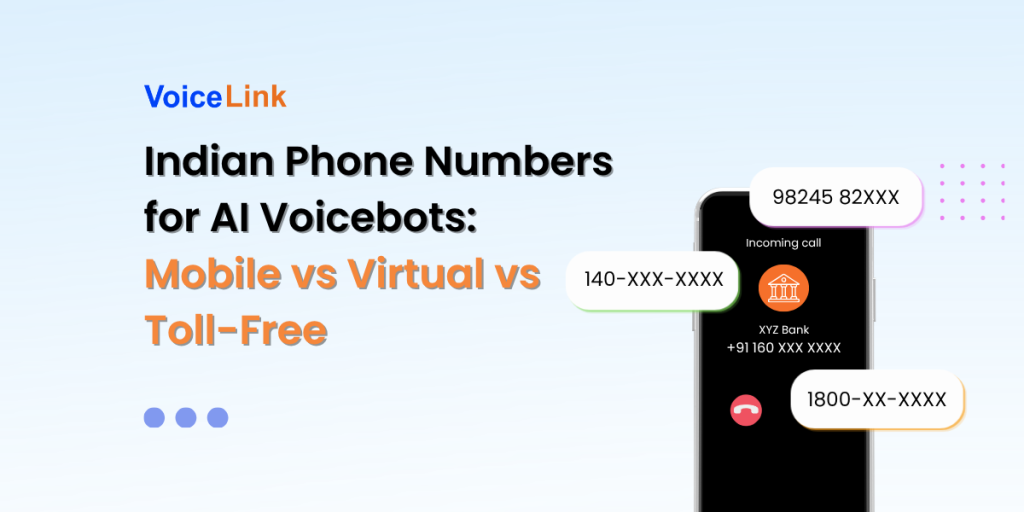
Decide whether the bot is placing service/transactional calls (1600 series) or promotional/outbound calls (140 series) — the two aren’t interchangeable, and TRAI’s July 2026 clarification (Press Release 91/2026) confirmed 1600-series calls can’t be blocked or filtered by caller-ID apps, while 140-series calls remain subject to DND-app blocking. Getting this wrong on day one means re-provisioning later.
-
Point your SIP trunk or WebSocket endpoint at the new provider, in parallel
Run the new Indian number alongside the existing Twilio number rather than cutting over directly. Most voicebot platforms (Retell, Vapi, ElevenLabs, LiveKit) accept multiple trunk configurations, so a portion of inbound or outbound traffic can validate the new connection before it carries everything else.
-
Re-test the parts of the call flow that are audio-timing sensitive
Barge-in handling, silence detection, and bot-to-agent handoff are all timing-dependent. A provider swap changes the audio path even when the API surface looks similar, so these need re-validation, not just a connectivity check.
-
Confirm number reputation before scaling volume
A newly provisioned Indian number with no call history is more exposed to carrier spam-tagging than an established one, particularly on the Airtel network. Ramp call volume gradually and monitor connectivity rates rather than switching 100% of traffic on day one.
-
Keep the Twilio number live for 30 days before decommissioning
Callback flows, stored recordings referencing the old number, and any hardcoded fallback logic all need time to surface. Thirty days of parallel operation is a reasonable buffer before closing the account.
The compliance question, in short: do you need your own VNO license?
No — not if you’re working with a provider that already holds one. A DoT Virtual Network Operator license, or a direct relationship with a licensed VNO who resells access under their license, is the legal basis for originating calls from an Indian number at all. VoiceLink holds this directly; that’s the mechanism that lets a voicebot team skip the licensing process entirely rather than obtaining it independently.
The number-series rule that trips teams up most: a 10-digit mobile number bought without series-specific registration is not a substitute for correct 1600 or 140 provisioning, whatever the call type. That’s a compressed summary — the full breakdown of TCCCPR requirements, consent rules, and per-violation exposure lives in VoiceLink’s SIP trunking and AI voice calling compliance guide, which is worth reading in full before finalizing a provider decision rather than relying on the summary here.
Proof this isn’t theoretical
10MDaily calls run on VoiceLink by Refrens, a B2B SaaS platform serving 150,000+ businesses across 178 countries. Read the full case study.
15Mn+Average monthly calls for GreyLabs AI’s Voice AI Agent Platform, serving 100+ BFSI institutions across India. Read the full case study.
94%Call connectivity achieved by Century Real Estate after moving high-volume lead-gen calling onto VoiceLink. Read the full case study.
Glossary
- DLT registration
- Distributed Ledger Technology-based registration Indian telecom operators require for certain commercial calls and messages, used to trace and verify the sender.
- Number porting
- Transferring an existing phone number from one operator or provider to another, rather than provisioning a new one — generally not how a Twilio-to-India-VNO migration works, since Twilio’s numbers are typically not India-licensed to begin with.
- BYOC (Bring Your Own Carrier)
- An architecture where a voicebot platform lets you connect your own telephony provider instead of using the platform’s bundled default — the mechanism that makes a mid-project telephony swap possible without rebuilding the bot.
- Parallel run
- Operating the old and new telephony providers simultaneously during migration, routing a portion of real traffic to the new provider before fully cutting over.
Frequently Asked Questions
Can Twilio be used in India?
Twilio can route calls that touch India, but it doesn’t offer genuine Indian local number provisioning (mobile or landline series) the way India-first VNO-licensed providers do, and it doesn’t hold an India VNO license directly. For a voicebot that needs to place or receive calls from an Indian-looking number, registered under the correct TRAI series, that gap is the practical limitation, not raw connectivity.
Is there a better alternative to Twilio for building voice agents in India?
For India-specific voice AI, yes — a provider built around Indian numbers and VNO licensing will generally get a voicebot to a compliant, connectivity-optimized production state faster than a global platform where India compliance has to be researched and built separately. For multi-country deployments where India is one market among several, Twilio’s broader global footprint may still be the better fit.
Is Plivo cheaper than Twilio for India voice AI?
Plivo is often positioned as a lower-cost alternative to Twilio globally, but like Twilio, its published pricing is USD-denominated and its India-specific documentation on VNO licensing and the 1600/140 series distinction is thin. Cost savings on a global rate card don’t address the compliance gap.
Can I migrate my voicebot from Twilio to an India-first provider without rewriting my bot?
In most cases yes. If your voicebot platform (Retell, Vapi, ElevenLabs, LiveKit, etc.) supports BYOC or multiple SIP trunk configurations, the migration is a telephony-layer swap rather than a bot rebuild — you re-point the trunk or WebSocket endpoint and re-test timing-sensitive behavior like barge-in and handoff.
What happens to my existing Twilio SIP trunk when I switch?
Nothing, until you decommission it. The standard approach is to keep the Twilio trunk live and run it in parallel with the new provider for a validation period — commonly around 30 days — before closing the account, so callback flows and any hardcoded references have time to surface.
Does switching providers affect my TRAI compliance status?
It can improve it, if the new provider handles VNO licensing and number-series registration directly — but only if the correct series (1600 for service/transactional, 140 for promotional) is provisioned before the switch, not assumed to carry over from a generic number.
Sources & Compliance References
- Telecom Regulatory Authority of India (TRAI) — Press Release No. 91/2026, clarification on 1600 and 140 number series, July 2026: trai.gov.in
- Department of Telecommunications, Government of India — VNO licensing framework and eServices portal: eservices.dot.gov.in
About this guide
Published by VoiceLink, September 2026. Provider claims are based on each company’s own published pages and documentation as of publication, current TRAI/DoT guidance, a comparative rate published by a third-party voice AI platform (cited above), and VoiceLink’s internal competitive analysis for details not publicly documented by competitors (DID charge structures, individual-KYC availability, and bot-to-agent handoff support) — verify current compliance requirements directly with TRAI/DoT before finalizing a provider decision, as number-series regulations are subject to amendment. Recommended review cadence: every 6 months, or immediately following a TRAI/DoT ruling affecting number-series rules.
Ready to see what switching looks like on your own numbers?